
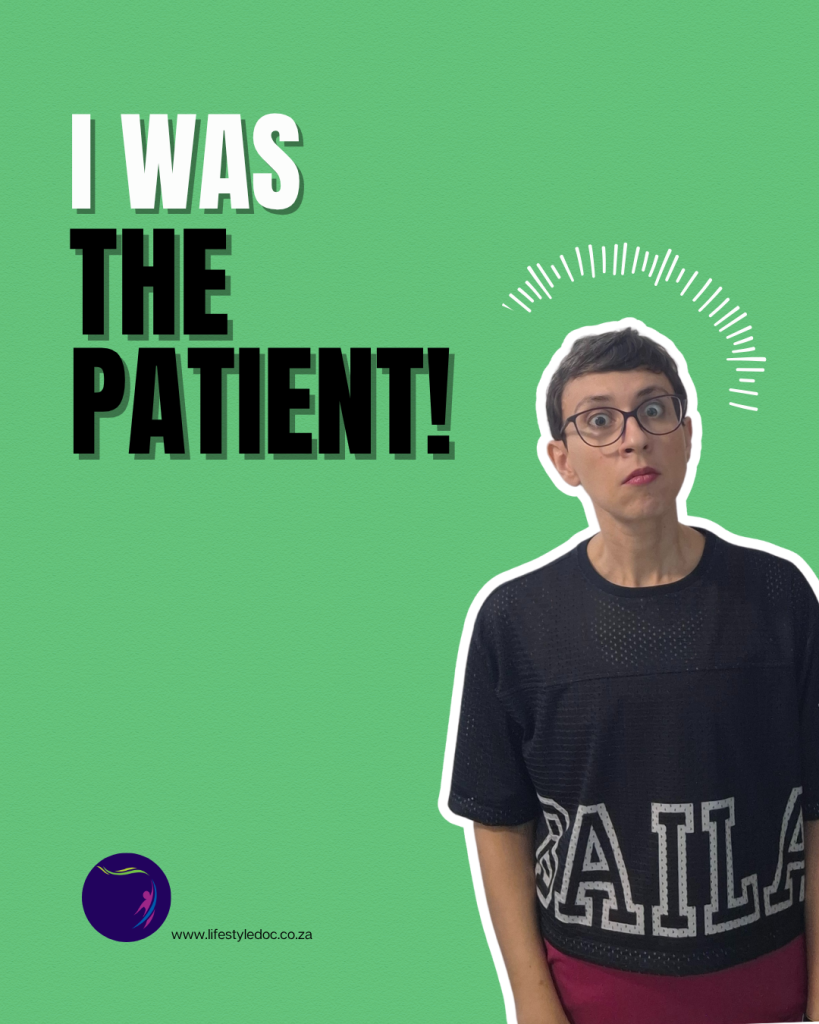
I was the patient!
When I look in the mirror today, it is hard to believe that I was morbidly obese. It feels like a different life. But, it’s true. At my heaviest I weighted 112kg and I faced some serious health threats: Pre-diabetes, high blood pressure, thyroid dysfunction and PCOS. Living that reality has shaped my career choices, and I live every day with the legacy of once being fat, and constantly making lifestyle decisions that prevent me from going back there.
I want to tell you the whole story — including the parts I rarely talk about publicly — because I think it matters. Not because a doctor who struggled with her own health makes for a useful and perhaps intriguing cautionary tale, but because the full trajectory of what happened to me is the reason I do the work I do. And it is the reason I believe, more firmly than I believe almost anything else, that what you eat shapes far more than your waistline.
How It Started
I grew up eating the way many children in my generation ate. Fast food. Chips and sweets after school. Chocolate bars, pies, pastries. Tuck-shop treats every breaktime. Refined carbohydrates at every meal and sugar woven through everything in between.
I did not think of it as harmful. Nobody around me did. It was simply how we ate — conveniently, cheaply, pleasurably. And I loved it. More than I should have, in retrospect. There was something compulsive about it — the way certain foods made me feel good for a moment and then left me reaching for more. I know now that this is not a character flaw. It is neurobiology. Ultra-processed foods are engineered to override your brain’s satiety signals, hijack your dopamine system, and keep you coming back for more. I was not weak. I was a child eating food that had been scientifically designed to be addictive.
At an age when most teenagers were thinking about exams and weekends, I was managing a body that felt like it was working against me. Tired and lethargic all the time, for no obvious reason. Anxious. Hormonally dysregulated. Carrying the physical weight and the psychological weight of it largely in silence, because nobody had the vocabulary then — or the courage — to talk about it honestly.
The First Attempt — and What It Cost Me
I lost the weight before I started medical school. And I want to be honest about how, because it is not the triumphant part of the story. Not yet.
Through extreme restriction. For years — and I mean years — my diet was essentially tuna in brine with frozen peas, or steamed butternut. No fat. No sugar. Nothing that felt like it might tip the scales back in the wrong direction. I was so frightened of regaining the weight, so haunted by what I had been and what it had cost me, that I ate as little and as carefully as I possibly could for as long as I could sustain it.
The diagnoses reversed. Blood pressure normalised. Hormonal picture improved. Metabolic markers came back into range. My doctors were pleased. By every measurable standard, what I did worked.
But the body keeps score.
Extreme restriction stripped me of muscle mass in a way that exercise alone could not compensate for. My skin — deprived for years of the protein, collagen, and elastin it needed to maintain its structure and elasticity — did not shrink back the way skin is supposed to when weight is lost properly. It hung. It would not recover. Eventually, I underwent plastic surgery to address what years of fat-free, near-protein-free eating had done to my body’s connective tissue.
I was slim. My bloodwork was better. And I had unknowingly starved my body of the very building blocks it needed to heal itself.
What Medical School Did Not Teach Me
I went on to study medicine. And I will say this with conviction: the nutrition training I received there did not serve me well.
We were taught the dietary guidelines of the era — base every meal on carbohydrates, keep fat low, avoid cholesterol, eat frequently to “keep your metabolism supported.” I followed that guidance as faithfully as I followed everything else I was taught. It did not occur to me to question it. I was a medical student. These were the guidelines.
What I understand now is that for someone with my history — a background of insulin resistance, metabolic dysfunction, and a brain wired toward processed food reward — a high-carbohydrate, low-fat diet is precisely the nutritional environment in which those tendencies thrive. I was eating in the way I had been told was healthy. I was not getting worse, exactly. But I was not getting better either. Not in the way I now understand better to mean.
The Turn
It was only after years of clinical practice and during my post-graduate training in Lifestyle Medicine that things genuinely shifted.
Not a single moment of revelation — more a gradual accumulation of evidence, of researching, of clinical observation, of personal experimentation, that led me to a way of eating I can honestly describe as the first time I have felt truly well.
A low-carbohydrate Mediterranean approach. Real food. Quality proteins, eaten without the guilt and fear that had followed me since adolescence. Healthy fats welcomed back after years of avoidance. Vegetables in abundance. No refined carbohydrates and no refined sugar. Intermittent fasting integrated naturally into my day.
The physical changes were significant. But the most profound shift was neurological.
My energy stabilised in a way it never had before — not the artificially propped-up energy of caffeine and sugar, but a genuine, sustained alertness that carried through the day. My thinking sharpened. The low-grade anxiety that had been a background feature of my life for as long as I could remember began to recede. I slept properly. I recovered well from exercise. I felt, for the first time, as though my brain and my body were finally cooperating.
I now take no medications and no supplements. I teach Zumba fitness classes three times a week. At this point in my life I am in better health than I was at twenty-five — which is something I could not have imagined when I was a teenager.
The Connection Nobody Talked About
Here is what took me the longest to fully understand, even as a doctor: the food I had been eating all those years was not just affecting my body. It was affecting my brain.
When I was a teen eating fast food and ultra-processed meals every day, the chronic blood sugar spikes, the insulin surges, the systemic inflammation were not only laying the groundwork for obesity and metabolic disease. They were disrupting the neurological systems that regulate mood, motivation, and mental clarity. The anxiety I felt was not purely circumstantial. The fatigue was not simply because I was overweight. My brain was operating in a biochemical environment that made those symptoms almost inevitable.
And when I swung in the opposite direction — eating almost nothing, stripping out all fat, surviving on protein so minimal it could not support basic tissue repair — I traded one form of nutritional damage for another. The flatness, the exhaustion, the cognitive fog of those years was my brain running on fumes.
This is not a metaphor. Your brain is more than 60% fat when stripped of water. It requires a continuous and generous supply of specific vitamins, minerals, proteins, and fatty acids to produce the chemical messengers that govern how you feel, how you sleep, how you respond to stress, how connected you feel to the people and purposes that matter to you. Every meal either builds that system or undermines it.
Nobody told me this. Not as a child. Not in medical school. Not in my early years of practice. I had to find it the hard way, through my own body, over many years.
Your brain underpins everything you value in your life. It deserves to be fed accordingly.