
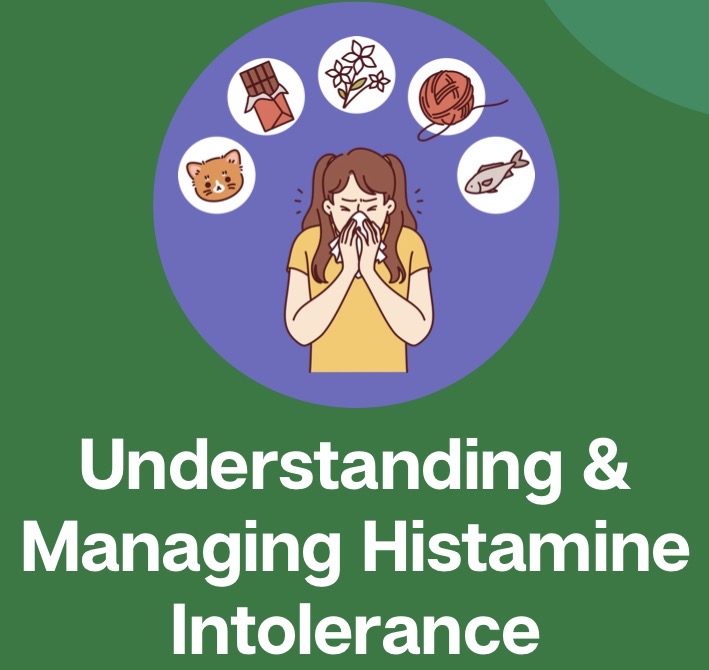
When the Immune System Won’t Calm Down: Mrs GL’s Story, and What a Low-Histamine Approach Taught Us
A few years ago, a patient walked into my consulting room who I still think about often. I’ll call her Mrs GL — 68 years old, she’d always been well and fit, but now she was utterly exhausted by her own body.
It had started with a seafood reaction severe enough to frighten her. But it didn’t end there. In the months that followed, her body seemed to stay on high alert: skin rashes that came and went, relentless itching, wheezing, eyes that wouldn’t stop watering and scratching.
She’d already done the rounds — an allergologist, a dermatologist, an immunologist, a pulmonologist. Each specialist treated their corner of the problem well. She was on antihistamines, oral cortisone, topical steroids, and inhalers, and each of these helped a little. But nothing held. The smallest trigger — a change in temperature, a stressful week, a hard workout, certain meals — would set the whole system off again.
By the time she sat across from me, Mrs GL wasn’t just physically unwell. She was profoundly miserable. And here’s the part that turned out to matter most: her misery was making the physical symptoms worse.
The Piece Nobody Had Joined Up
This is something I find myself explaining to patients again and again: the nervous system and the immune system are not separate departments. They talk to each other constantly. Chronic stress keeps the body’s threat-detection system switched on, and that includes the cells responsible for releasing histamine — the chemical behind so many allergy-type symptoms. So a body already struggling to clear histamine efficiently, sitting in a prolonged stress state, ends up in a loop: symptoms cause stress, stress amplifies symptoms, and round it goes.
Every specialist Mrs GL had seen was, in a sense, correctly treating the histamine symptoms. Antihistamines block histamine receptors. Cortisone dampens inflammation. Inhalers ease the airways. But none of these address why her histamine load kept climbing in the first place — including what was going in through her fork every day.
What We Tried
I suggested something that hadn’t been part of her treatment yet: a low-histamine diet, alongside some simple lifestyle changes to support her nervous system.
In practice, this meant:
- Cutting back on the usual histamine-heavy culprits — cured and smoked meats, aged cheeses, fermented foods, leftovers, alcohol
- Shifting toward fresh, simply prepared foods, eaten the same day rather than reheated (leftovers tend to be higher in histamines)
- Bringing in foods that actively support histamine clearance and calm mast-cell activity — herbs like dill, oregano, and basil, fresh poultry, colourful fruit and vegetables
- Paying attention to the non-food triggers too — sudden temperature shifts, exertion, environmental chemicals, and above all, stress
Nothing exotic. No supplements to start, no elimination extremes. Just a genuinely different histamine load on her system, day after day.
The Turnaround
Within two weeks, Mrs GL was noticeably better. Not “a bit less itchy” better — better enough that we could begin tapering her off oral cortisone. Over the following months, we weaned her off the antihistamines and the rest of her medication, one by one, watching her symptoms carefully.
Today, years on, Mrs GL lives an essentially normal life. She still gets ordinary hay fever in season, and the odd mild eczema flare — the sort of thing most people deal with. But she hasn’t had another major allergic-type reaction since. She knows her personal triggers now, keeps her histamine intake reasonably in check, and — perhaps most importantly — she’s no longer afraid of her own body.
What This Case Taught Me
I share Mrs GL’s story not because a low-histamine diet is a miracle cure — it isn’t, and it won’t be the answer for everyone with allergy-type symptoms. But her case is a good reminder of a few things I think about often in lifestyle medicine:
- Symptom control and root-cause management aren’t the same thing. Medication can be genuinely necessary, and it was for Mrs GL, for a time. But asking “what’s driving this?” alongside “how do we suppress it?” can change the entire trajectory.
- The body doesn’t compartmentalise the way our medical specialities do. Skin, airways, gut, and nervous system are all cross-talking. A histamine-related presentation can show up as a dermatology problem, a respiratory problem, or an allergy problem — often all three in the same patient.
- Stress isn’t a footnote. It’s a physiological input with measurable effects on immune and mast-cell activity, not just “in your head.” Addressing it isn’t optional in cases like this — it’s part of the treatment.
- Small, sustainable changes can produce dramatic results. Mrs GL didn’t overhaul her entire life. She changed what was on her plate and paid attention to her stress load, and her body did the rest.
If This Sounds Familiar
If you recognise any of this in yourself — unexplained skin reactions, flushing, digestive upset, headaches, or a sense that your allergic-type symptoms flare with stress, weather, or certain foods — it may be worth discussing histamine intolerance with your doctor.
I’ve put together a full patient guide covering exactly what we used with Mrs GL: which foods to reduce, which foods actively help, and the everyday lifestyle factors that make the biggest difference.
Read the low-histamine diet & lifestyle guide
As always, please don’t stop or change any prescribed medication without discussing it with your own doctor first — Mrs GL’s tapering was done gradually, under medical supervision, alongside her diet and lifestyle changes.