
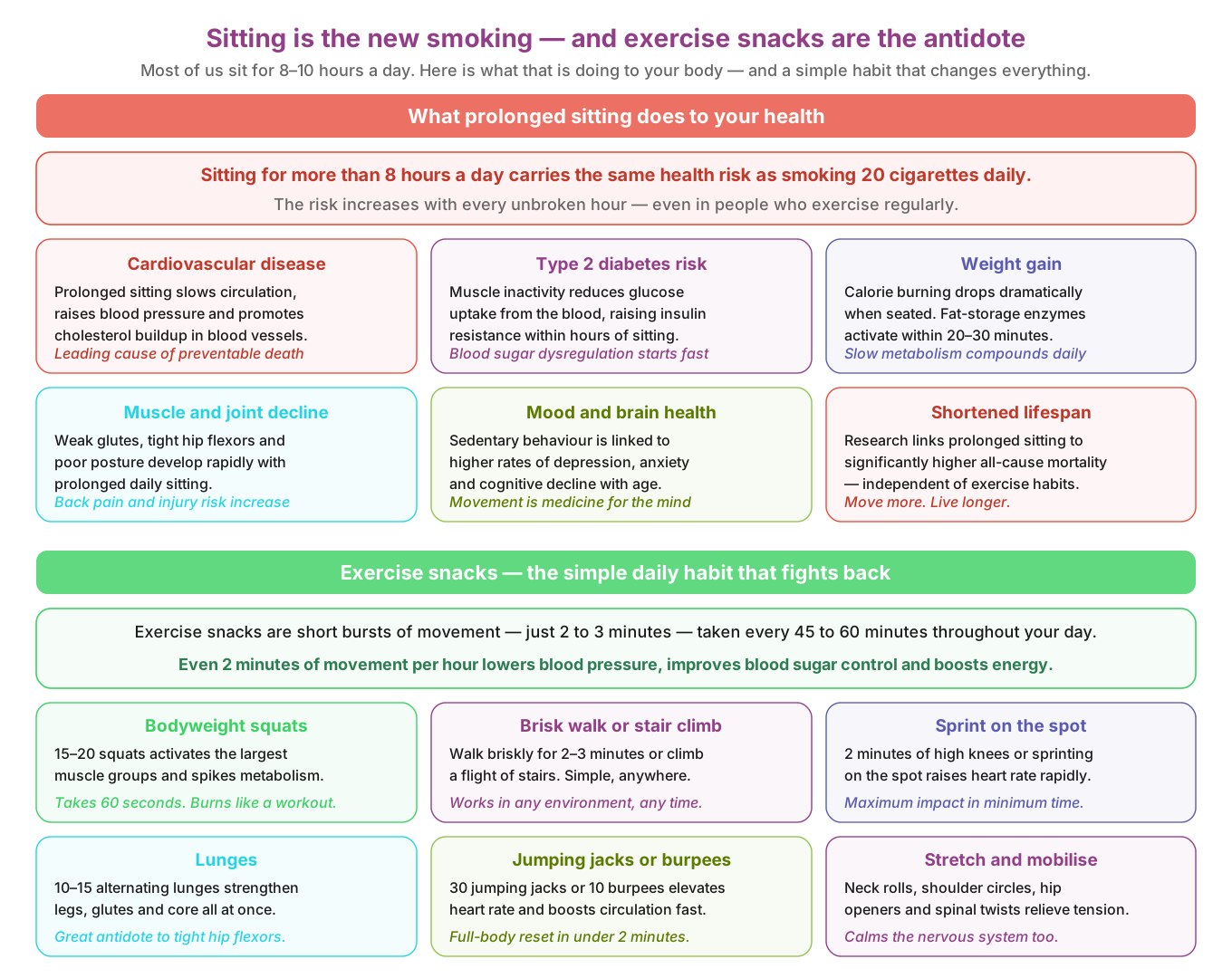
Sitting is the new smoking – and exercise snacks are the antidote!
You Exercise Every Day. So Why Is Your Health Still Suffering?
Here is a question that stops most of my patients cold.
You go to the gym three times a week. You walk on weekends. You are, by any reasonable measure, an active person. And yet your blood pressure is still creeping up. Your waist is still expanding. Your energy slumps every afternoon like clockwork. Your doctor keeps mentioning your blood sugar.
What is going on?
I see this pattern in my consulting room more often than almost any other. And in most cases, the answer has nothing to do with how hard you exercise, what you eat, or how disciplined you are. It has to do with what you do for the other 23 hours of the day.
Specifically, how long you spend sitting down.
The Most Uncomfortable Health Statistic You Will Read Today
Sitting for more than eight hours a day carries the same health risk as smoking twenty cigarettes daily.
That sentence usually produces one of two reactions: disbelief, or a slow, dawning recognition. Because when you add it up — the commute, the desk, the meetings, the couch, the dinner table, the screen before bed — most working adults are sitting for ten, eleven, sometimes twelve hours every single day.
And here is the part that surprises even my most health-conscious patients: exercising once a day does not undo it. A one-hour workout cannot compensate for ten hours of physical stillness. The research on this is robust, and the implications are significant. Prolonged sitting is an independent risk factor for serious disease — independent meaning that it raises your risk even when you exercise regularly.
This is not a reason to despair. It is a reason to understand what is actually happening in your body, and to make one small but powerful change to your daily routine.
What Sitting Is Doing to Your Body Right Now
Let me walk you through what happens physiologically when you sit for long stretches without moving.
Within the first twenty to thirty minutes of sitting, fat-storage enzymes in your muscles activate. Your calorie-burning rate drops to its lowest possible level — lower than slow walking, lower than standing, barely above sleeping. Your muscles, which in an active state act as a sponge for blood glucose, become passive. Blood sugar rises. Insulin rises in response. Do this repeatedly across a day, across a week, across years, and insulin resistance follows — the precursor to type 2 diabetes, weight gain and metabolic syndrome.
Simultaneously, circulation slows. Blood pools in the lower legs. The cardiovascular system, designed for movement, begins to strain under the demand of pumping blood through a largely static body. Blood pressure rises. Inflammatory markers increase. The risk of cardiovascular disease climbs with every unbroken hour of sitting.
Your posture deteriorates. The hip flexors shorten and tighten. The glutes — the largest and most metabolically important muscle group in the body — become underactivated and weak. The lower back bears the load it was never designed to carry alone. Back pain, which affects more than 80% of adults at some point in their lives, is in large part a sitting disease.
And then there is the brain. Sedentary behaviour is independently associated with higher rates of depression and anxiety. Physical movement drives the release of endorphins, serotonin and brain-derived neurotrophic factor — chemicals that regulate mood, sharpen cognition, reduce stress and protect the brain from age-related decline. When movement stops, so does much of this neurochemical support. The afternoon slump, the low-grade irritability, the inability to concentrate after hours at a desk — these are not personality traits. They are physiological responses to stillness.
Meet Nalini
Nalini is 51 years old, a school principal, and one of the most disciplined people I have ever met. She exercises five mornings a week — a 40-minute brisk walk before school, without exception. She eats well. She sleeps reasonably. She does not smoke and drinks rarely.
She came to see me because her blood pressure had reached the point where her previous doctor was discussing medication. Her fasting glucose was in the pre-diabetic range. She had gained eight kilograms over three years despite no change in her diet or exercise habits. She was exhausted by 3pm every day. She told me she felt like her body was ageing faster than it should be.
When I asked her to describe a typical working day, the picture became clear immediately. She arrived at school at 7am and was in back-to-back meetings, classes and administrative sessions until 4pm. She estimated she sat for roughly nine hours between arriving and leaving. Her 40-minute morning walk, as valuable as it was, was being metabolically undone by the nine hours of stillness that followed it.
I did not prescribe medication. I prescribed movement breaks.
Every 45 minutes, without exception, Nalini was to stand up and move for two to three minutes. Walk to a colleague instead of sending an email. Do ten squats in her office. Walk the length of the school corridor and back. Nothing dramatic. Nothing that required changing clothes or rearranging her day.
Within eight weeks, her blood pressure had dropped to normal without medication. Her afternoon energy returned. Her fasting glucose normalised over the following three months. She lost four kilograms without changing a single thing about her diet or her morning walks.
“I can’t believe something so small made such a big difference,” she told me at her follow-up.
It is not small, I told her. It is fundamental.
The Science of Exercise Snacks
The concept of exercise snacks — short bursts of movement distributed throughout the day — has emerged from exercise physiology research as one of the most practical and effective interventions in preventive medicine.
The term sounds lighthearted, but the evidence behind it is serious. Studies show that just two to three minutes of movement every hour produces measurable improvements in blood sugar regulation, blood pressure, circulation and metabolic rate. The effect is not simply additive — frequent movement throughout the day appears to activate metabolic pathways that a single longer session cannot fully replicate, because the body responds differently to continuous low-level activation than to one intense burst followed by prolonged rest.
You do not need equipment. You do not need to change into gym clothes. You do not need to leave the building. You need approximately two minutes, a small amount of floor space, and the intention to move regularly.
Fifteen to twenty bodyweight squats take roughly sixty seconds and activate the gluteal muscles, quadriceps and hamstrings — the largest metabolic engines in the body. Ten to fifteen alternating lunges address the hip flexor tightness that builds up with sitting and strengthen the legs and core simultaneously. Thirty jumping jacks or ten burpees elevate the heart rate rapidly, improve circulation and provide a neurochemical reset that the coffee you are probably reaching for around 3pm cannot match. Sprinting on the spot for two minutes — high knees, arms pumping — is arguably the most efficient two-minute health intervention available to any person sitting at a desk.
And on days when the body is tired or the back is aching, two to three minutes of gentle movement — neck rolls, shoulder circles, hip openers, a slow spinal twist — releases muscular tension, calms the nervous system and reactivates the circulation without any cardiovascular demand at all.
The rule is simple: every 45 to 60 minutes, stand up and move. Set a phone reminder if you need to. Put a note on your monitor. Tell your colleagues. Make it non-negotiable.
Meet David
David is 38 years old, a software developer, and he came to me not because he was worried about his health but because his wife had insisted. He felt fine, he said. He was just tired all the time, a bit heavier than he used to be, and had been having headaches most afternoons for the past year.
His working day involved sitting at two monitors for eight to ten hours, broken only by a lunch he usually ate at his desk. He had not exercised regularly since university. His blood pressure was elevated. His resting heart rate was 88. His body mass index placed him firmly in the overweight category.
David was not interested in a gym. He was not ready to overhaul his diet. He was, however, willing to try something that would not disrupt his workday.
I asked him to do one thing: set a timer on his phone for every 45 minutes, and when it went off, stand up and do something physical for two minutes. Anything. Walk to the kitchen. Do some squats. Walk up and down the stairs. Stretch. Whatever felt manageable.
He came back six weeks later looking slightly sheepish. His blood pressure had dropped significantly. His afternoon headaches had almost entirely stopped. He had lost two kilograms without changing his diet. His resting heart rate had come down to 74.
“It seems too easy,” he said.
Most of the best interventions in lifestyle medicine are, I told him. The difficulty is never the complexity of the solution. It is the consistency of the practice.
What This Means for You
If you have read this far, there is a reasonable chance that some part of this resonates. Perhaps you sit at a desk for most of the day. Perhaps you exercise and still do not feel as well as you think you should. Perhaps your blood pressure, blood sugar or weight has been slowly moving in the wrong direction despite your genuine efforts.
The message is not that exercise is useless — it is profoundly valuable and I recommend it unreservedly. The message is that movement and exercise are two different things, and your body needs both. It needs a dedicated session of structured exercise, and it needs to move, in small ways, consistently throughout the day.
Your cardiovascular system, your metabolic health, your brain, your mood, your posture, your energy and your longevity are all shaped not just by what you do in your best hour, but by what you do in every hour.
Stand up. Move for two minutes. Do it again in 45 minutes.
That is not a small thing. That is the foundation of a healthier life.