
Comfort eating: when food becomes emotional first-aid (and how to break the cycle)
If you’ve ever found yourself standing in front of the fridge thinking, “I’m not even hungry… I’m just… done,” you’re not alone.
One of my colleagues, psychologist Dr Micki Pistorius, puts it bluntly: ‘Food isn’t meant to be emotional comfort, it’s meant to be nourishment for your body.’ And yet, most of us were trained from childhood to use food as a “feeling fixer”.
- Good behaviour? Sweet reward.
- Birthday? Cake.
- Sad day? Ice cream.
- Stressful day at work? Cookies.
- Tension at home? A packet of chips.
So it makes perfect sense that, as adults, food becomes the fastest “off switch” we know.
A real-life example (you’ll probably recognise parts of it)
A lovely woman came to see me for weight loss advice. Her life was full of relentless pressure:
- She was the sole caregiver for her son born with cerebral palsy, requiring constant attention and support.
- She worked as a virtual assistant, with a boss who had no respect for boundaries. She felt “on call” all the time.
At night, when the house finally went quiet, she reached for comfort:
a chocolate croissant, a crème caramel, a packet of marshmallows.
Those foods gave her something she desperately needed: a moment of relief.
But they weren’t serving her health. And they were slowly locking her into a cycle she couldn’t seem to escape.
This post is about that cycle: why it happens (socially, psychologically, and biologically), why it backfires, and what to do instead… in a way that’s practical for real life.
What “comfort eating” actually is
Comfort eating is when we use food primarily to change how we feel rather than to meet physical hunger.
It can look like:
- eating when stressed, lonely, angry, overwhelmed, bored, or numb
- craving very specific foods (usually sweet/salty/creamy/crunchy)
- feeling temporary relief followed by guilt, regret, bloating, fatigue, or cravings again
- feeling out of control around certain foods
Importantly: comfort eating is not a character flaw.
It’s a learned coping strategy + a nervous system response + a modern food environment that’s been designed to hook you.
Why comfort eating happens: the “perfect storm”
1) Social learning: we were trained to link food to emotion
Many of us grew up in homes (and cultures) where food meant:
- love (“I made your favourite”)
- safety (“don’t be scared, eat something”)
- celebration (“cake!”)
- soothing (“have a sweetie, don’t cry”)
So the brain learns a simple equation early:
Big feelings → food → relief
That association becomes automatic, especially under stress.
2) Psychological drivers: food becomes emotional regulation
Comfort eating often isn’t about food. It’s about what food does for you in that moment.
Food can temporarily provide:
- distraction from difficult thoughts
- comfort when you feel unsupported
- a sense of control when life feels chaotic
- a “treat” when you feel deprived or underappreciated
- a break when you’re exhausted
- numbing when emotions feel too big
If someone is caregiving, burnt out, lonely, under chronic stress, or emotionally depleted, food becomes a reliable coping tool.
And it works… briefly, because of the effects on your brain chemistry and physiology.
3) The neurochemical / physiological basis: your nervous system is trying to self-soothe
When you eat highly palatable foods (especially ultra-processed sweets and snacks), several systems light up:
Dopamine (motivation + reward)
This is the “anticipation and reward” signal. It doesn’t just make you feel good… it makes you want to repeat the behaviour.
Endogenous opioids + endorphins (comfort + soothing)
Rich, sweet, and fatty foods can trigger calming, pain-dulling sensations that can make you feel really good (euphoria).
Serotonin shifts (mood regulation)
Carbohydrate-heavy comfort foods can temporarily boost feelings of calm or well-being in some people.
Blood sugar swings
A sugary snack may produce a quick rise, then a crash… which can feel like:
- fatigue
- irritability
- shakiness
- “I need something else”
You are physiologically driven to eat something again when you experience the energy dip. So your brain learns that: “Food fixes this feeling.”
And the habit becomes reinforced.
Stress hormones (cortisol) + appetite hormones (ghrelin/leptin)
Chronic stress often increases cortisol, which can:
- increase cravings (especially for sweet/fatty foods)
- increase appetite in many people
- make it harder to feel full and satisfied
Many people experience a loss of control of their appetite and eating habits when under stress because of the hormonal and neurological mechanisms at play.
4) Society and the food environment: you’re not “weak”, you’re being targeted
Modern ultra-processed foods are engineered for maximum reward and minimum fullness:
- combinations of sugar + fat + salt
- crunchy textures
- “melt in the mouth” foods that are easy to overeat
- constant availability, convenience, marketing, and social normalisation
If your nervous system is stressed and the environment is full of highly rewarding food, comfort eating becomes the default, and almost impossible to resist.
Why comfort eating stops serving you (even though it “helps” in the moment)
The short-term payoff
- you feel calmer
- you get a mini “escape” or distraction while eating
- you get a sense of pleasure
- you feel briefly soothed
The long-term cost
- cravings become stronger and more frequent
- you rely on food instead of building other coping strategies
- your metabolism suffers (especially with repeated sugar/snack cycles)
- energy, sleep, mood, and focus can worsen
- weight gain becomes more likely (not always, but often)
- guilt and shame creep in, which ironically triggers more comfort eating
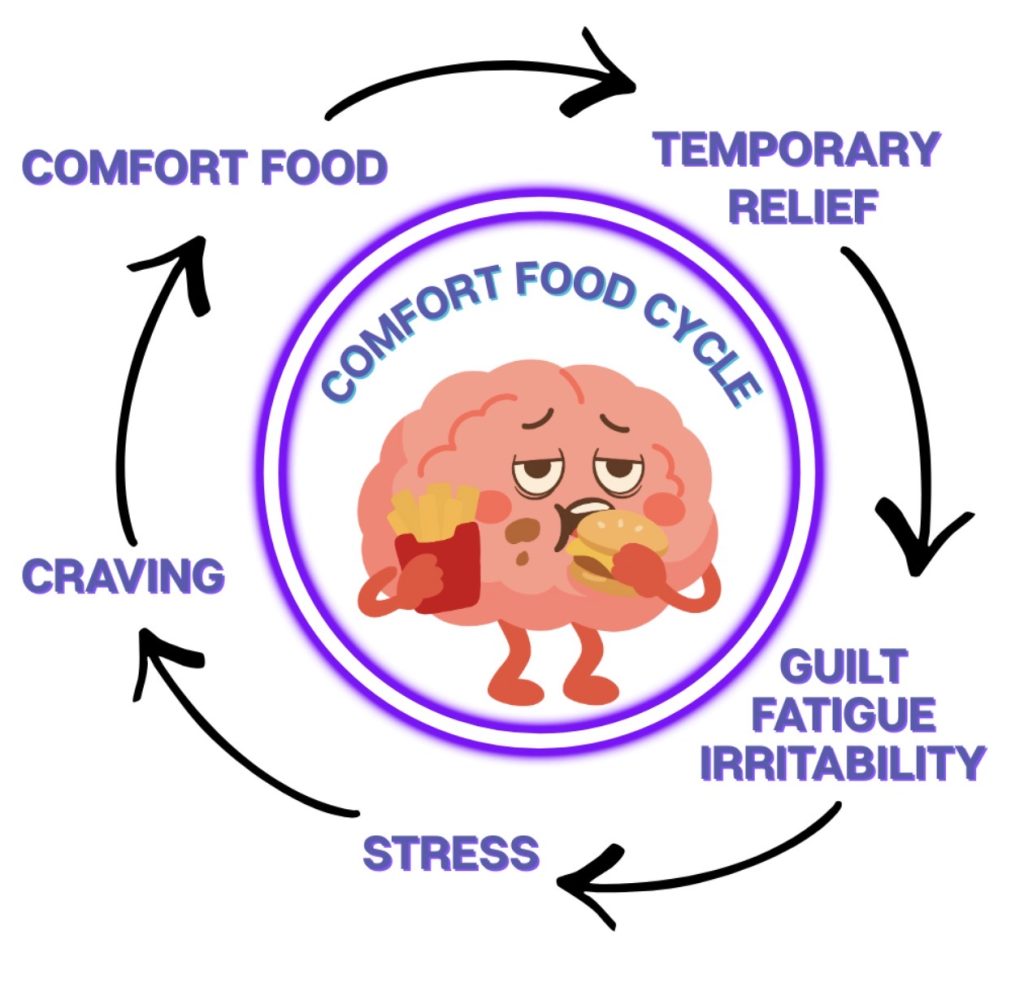
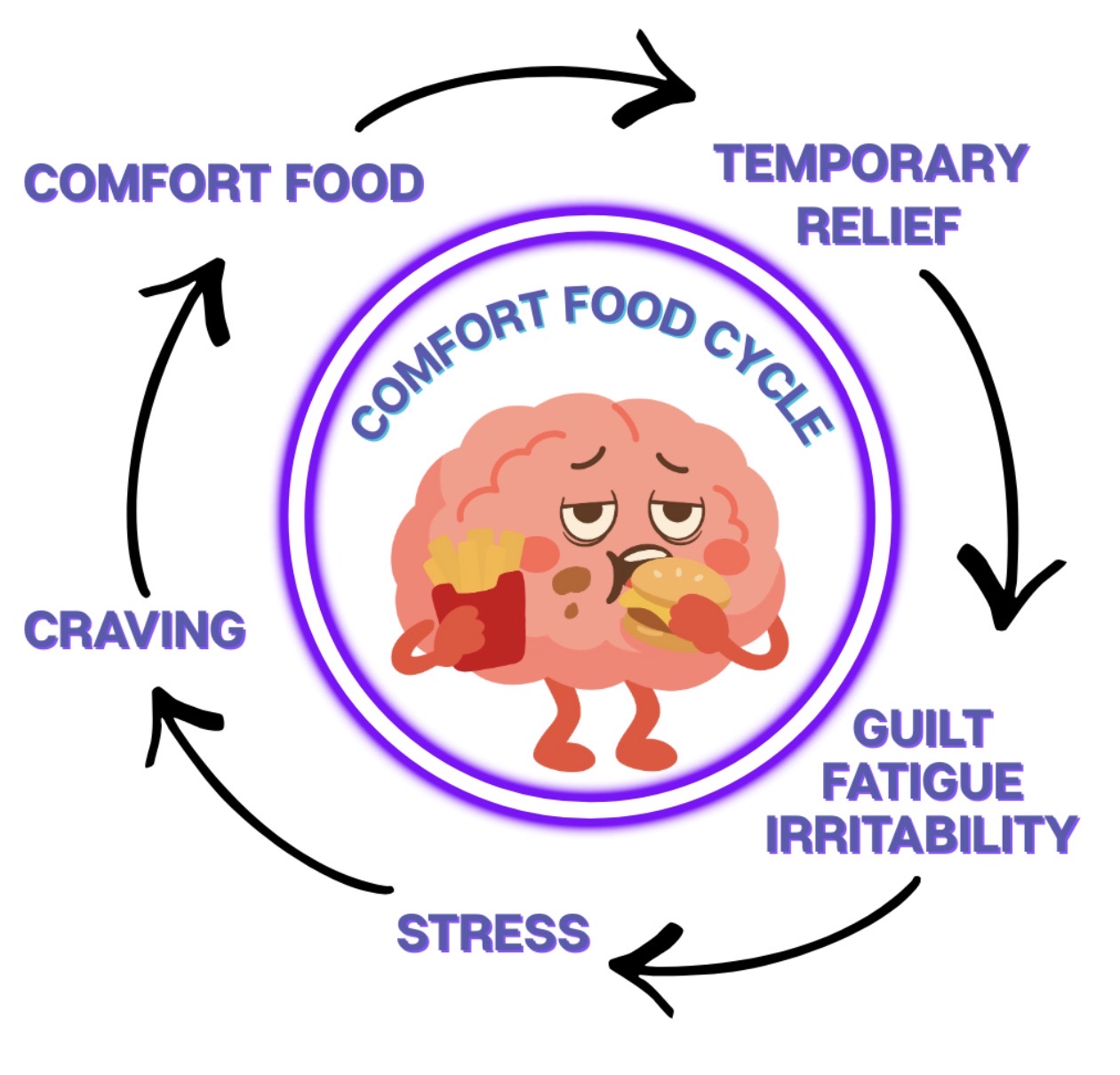
It becomes a loop:
Stress → craving → comfort food → temporary relief → guilt / fatigue / irritability / cravings → more stress
The two types of hunger you need to learn to separate
Many people find it difficult to differentiate between real physiological hunger and simply craving or wanting to eat for an emotional or other reason.
Here’s a simple way to tell what’s going on:
Physical hunger
- builds gradually
- many foods sound appealing (including vegetables)
- you can wait a bit – you don’t feel compelled to drop everything immediately and rush to the fridge
- you feel satisfied after eating
Emotional hunger
- sudden and urgent
- very specific cravings (chocolate, crisps, cookies, ice-cream, macaroni cheese…)
- feels like “I need it now”… the urge to eat can be overpowering and feel like an emergency
- often followed by guilt, not satisfaction
Both sensations are real. But they need different solutions.
Breaking the cycle: a practical plan that actually works
To download a handy workbook that includes all the practical skills provided in this blog, click here:
Step 1: Remove shame. Add curiosity
If you attack yourself with guilt, you add stress. And remember, stress fuels the cycle.
Try to consciously reframe how you feel like this:
“This is my nervous system looking for relief. How can I find relief that truly helps.”
Step 2: Identify your pattern (your personal comfort-eating “map”)
Use this quick check-in before eating:
HALT
- Am I Hungry?
- Angry (or irritated)?
- Lonely?
- Tired?
And add two more:
- Overwhelmed?
- Unappreciated?
If the answer is emotional rather than physical hunger, you don’t need willpower (or a snack). You need a different form of care.
Mini exercise (2 minutes): “Name the feeling”
Take a moment to identify what you are feeling emotionally. If you can give your emotion a NAME, you can understand the physical sensations in your body more accurately, and you can decide consciously how to address what you are feeling in the best way.
Write one sentence:
- “Right now I feel ______ because ______.”
This alone reduces emotional intensity for many people.
Step 3: Regulate your body first (because biology drives behaviour)
If you’re under-eating protein, skipping meals, sleeping poorly, or living on caffeine, you’ll crave comfort foods more.
Here’s another patient example from my practice: A lady who was eating a very healthy plant-based diet, and she said to me: “Dr Karen, I can’t help myself… every afternoon I find myself gorging on cookies. I know I’m not hungry. I just NEED to eat.”
She was eating less than 40g protein per day. By simply increasing the portions of protein-based foods (eggs, full-cream yoghurt, lentils and pulses, nuts and seeds), she found her mid-afternoon biscuit cravings disappeared.
Aim for “appetite stability” basics:
- Protein anchor at each meal (helps fullness and reduces snack cravings)
- Fibre first (vegetables, legumes if tolerated, chia/flax seeds, salads, soups)
- Healthy fats for satisfaction (olive oil, avocado, nuts, seeds, eggs, fatty fish)
- Hydration + minerals (dehydration and low electrolytes can masquerade as cravings)
- Sleep (poor sleep amplifies appetite hormones and cravings, and sabotages self-control)
A very practical rule:
If cravings hit daily, don’t start with “discipline”. Start with protein at all your meals and quality sleep.
Step 4: Build a “Comfort Menu” (so food isn’t the only option)
Most people try to “stop comfort eating” without replacing what it provides.
Create a list of comfort options in categories that could work for you. Here are some examples:
Fast comfort (2–5 minutes)
- make tea and sit outside for fresh air
- 10 slow breaths (longer exhale than inhale)
- take a shower or wash your face with cool water
- short stretch sequence
- music + one song dance break
- message a friend: “Rough day. Can I have a voice note hug?”
Nervous system comfort (10–20 minutes)
- walk (this is especially powerful if outdoors in nature)
- short home workout
- journaling “brain dump”
- guided meditation / prayer
- cuddling a pet
- creative hobby: colouring, crochet, gardening, baking something nourishing
Deep comfort (ongoing)
- therapy / CBT / trauma-informed support
- caregiver support group
- coaching for boundaries and assertiveness
- scheduling protected recovery time like it’s medication (put it in your diary like you would schedule any other important appointment or obligation)
If you’re caregiving or chronically stressed, this step is non-negotiable. Your brain needs proof that relief exists outside food.
Step 5: Make trigger moments harder (environment design beats willpower)
Simple but powerful tweaks:
- Don’t keep your biggest trigger foods in “easy access” zones. Remove the toaster from the counter, and pack it in a closed cupboard – seeing the toaster can trigger a craving for a slice of toast! Out of sight. Out of mind.
- Portion snack foods into single servings (or don’t buy them at all if they’re truly addictive for you).
- Create a “kitchen closed” routine in the evening (last meal, tea, brush teeth, lights dim/off in the kitchen).
- Replace the default snack/comfort food with a default nourishing option.
Here are nourishing replacements that still feel comforting:
| Craving type | What you’re often seeking | Healthier “comfort” alternatives |
| Sweet | quick dopamine + soothing | Greek yoghurt + berries + cinnamon; chia pudding; dark chocolate square with nuts; protein hot chocolate |
| Crunchy/salty | tension release + stimulation | roasted chickpeas; popcorn (minimal oil); carrots/cucumber with hummus; salted nuts (portioned) |
| Creamy | soothing + fullness | cottage cheese; avocado + eggs; soup; protein smoothie |
| “Chocolate + pastry” | reward + ritual | protein dessert bowl; peanut + date energy balls; berries + cream; low-carb chocolate granola with Greek yoghurt |
No, it’s not identical, but it breaks the addictive loop while keeping pleasure… and these options provide beneficial nutrition to your body and nervous system.
Step 6: Learn craving skills (so cravings don’t boss you around)
Cravings rise, peak, and fall like a wave — usually within 20-25 minutes.
Try one of these tools:
The 20-minute delay
- Tell yourself: “I can have it in 20 minutes if I still want it.”
- Set you alarm for 20 minutes.
- In the meantime…: drink water or have a cup of tea + go for a walk + do some deep breathing or stretching.
If you really still want the snack after your alarm goes off… have it without guilt.
Urge surfing
- Notice where you feel the craving in your body (mouth, chest, stomach).
- Rate it out of 10.
- Watch it change without feeding it. It may change position and intensity (usually, it will fade with time as you observe the bodily manifestation of the craving).
The “Veg or Protein first” rule
- Eat a bowl of crunchy veg or a salad first.
- Add a protein-rich food (eggs, yoghurt, tuna, biltong, protein shake).
- Then decide. (Cravings are often quieter once your body is fed.)
- If you still want the treat, you’ll likely want less.
Step 7: Use intermittent fasting strategically (not as punishment)
Intermittent fasting can be helpful for some people, because it can:
- reduce constant grazing
- teach you that hunger is not dangerous + that hunger is temporary
- help you practise “urge tolerance”
- create clearer eating boundaries
But it must be done with the right mindset:
- not as self-punishment after overeating
- not if it triggers binge/restrict cycles
- not if you have a history of eating disorders (or active disordered eating patterns)
A gentle approach that works well for many of my patients:
- Start with 12 hours overnight (eg. 7pm–7am)
- Build to 14 hours if you feel stable
- Prioritise protein + fibre in your eating window
- Always break your fast with a nourishing low-carb meal
The goal is not to “control yourself”. The goal is to re-train appetite cues and reduce constant reward-seeking.
Step 8: Address the real need underneath the eating
This is the heart of it.
If your comfort eating happens because:
- you’re emotionally exhausted
- you don’t feel supported
- you have no breaks
- your life has no boundaries
- you live in constant fight-or-flight
…then food is not the problem. It’s the symptom.
For the exhausted Mum I mentioned at the beginning of the article, a big part of her “treatment plan” wasn’t only nutrition. It was:
- boundaries with work (including learning to say “no”)
- creating protected off-duty time
- building support around caregiving
- finding small daily recovery rituals
- and yes, changing food, but with compassion, not punishment
Sometimes the most powerful question is:
“What am I truly needing right now, and what is the BEST WAY I can meet that need?”
When to get extra help
Please don’t try to white-knuckle this alone if:
- you feel out of control around food
- you hide eating or if you find yourself eating in secret
- you swing between restriction and bingeing
- your mood is low, anxiety is high, or you need to process trauma
- food is your main coping tool
A psychologist (CBT, DBT, or trauma-informed therapy), a dietitian familiar with emotional eating, or a lifestyle-medicine approach that includes nervous system regulation can be life-changing.
Where to start?
This is a fairly comprehensive outline of several tools you can apply to your life, but if it seems to be a lot…
Here’s a simple place to begin:
- Protein at breakfast (or your first meal) every day for 7 days
- Create a 10-item comfort menu (non-food) and use one item daily
- One craving skill: 10-minute delay or veg-first, daily practice
Not perfect. Not dramatic. But it starts to change entrenched habits and the wiring in your brain.
To download a handy workbook that includes all the practical skills provided in this blog, click here.
Remember:
Comfort eating isn’t you being “undisciplined”.
It’s your brain doing what it was taught to do: seek relief.
The goal isn’t to become someone who never wants comfort.
The goal is to build a life where comfort comes from things that genuinely restore you… And food returns to what it was always meant to be: physical nourishment.